
Models and cost
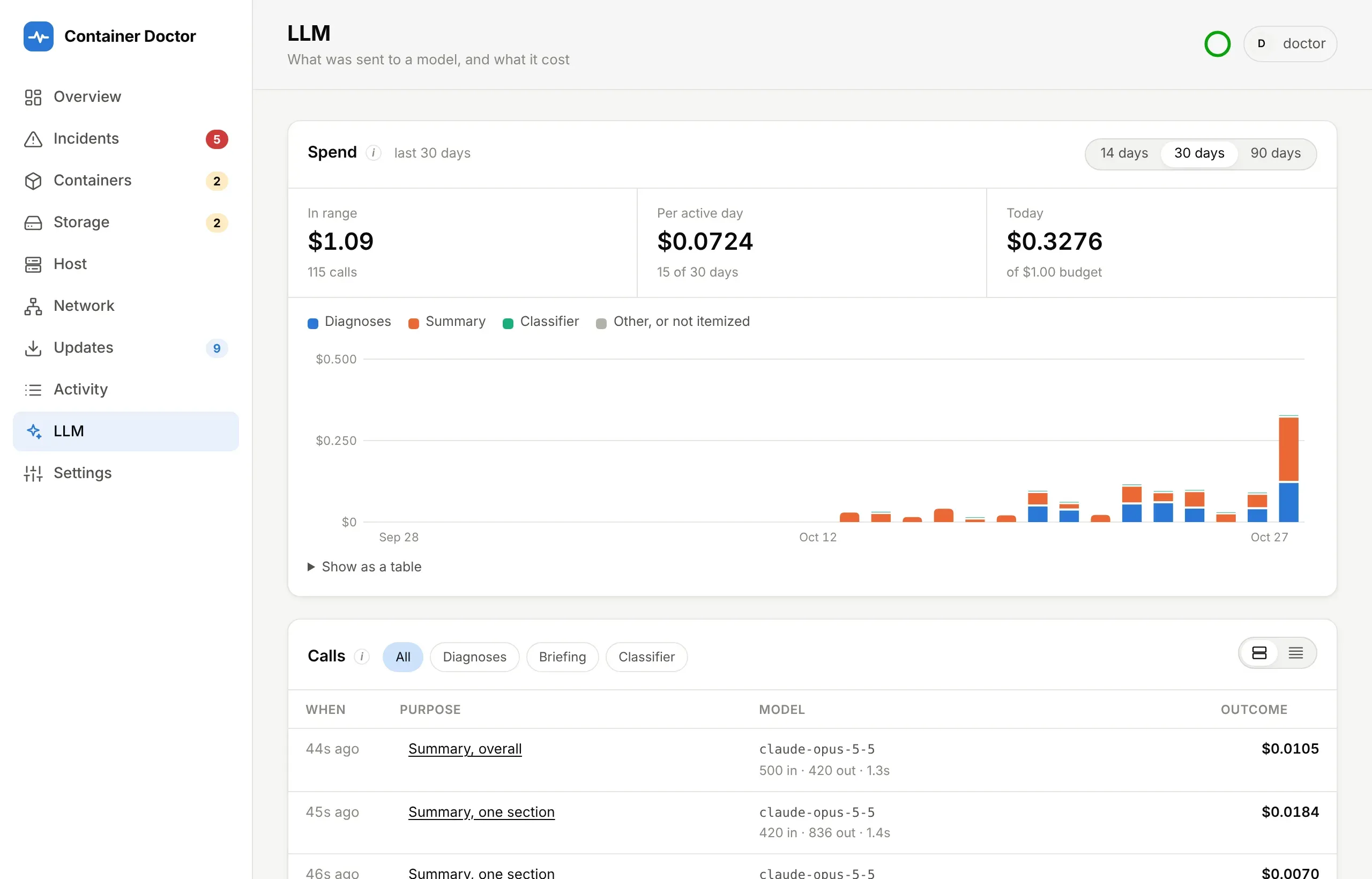
The LLM page answers two questions: what did the doctor send, and what did it cost.
Spend is a bar per day, split by what it paid for: diagnoses, the dashboard summary and the classifier. Choose 14, 30 or 90 days. Hover a day for its breakdown, or open the table view. The daily budget is drawn as a line when the bars get anywhere near it. Days older than the call log keep their total, shown as not itemized, because the daily totals are kept as long as the incidents.
Calls lists every request, newest first: its purpose, model, tokens, time taken and cost, or the error when it failed. Open one to read exactly what went out:
- the system prompt and the prompt, with the evidence already redacted;
- the answer schema and the parameters (effort, and how an OpenAI-compatible vendor accepted the request);
- the endpoint it went to;
- the answer as it came back.
A diagnosis links back to its incident. Copy the prompt puts the whole request on the clipboard.
The bodies are kept for DOCTOR_LLM_LOG_DAYS (default 14; 0 keeps none). A
failure to write the log is itself logged and never costs the call.
Cost and model choice
Section titled “Cost and model choice”Two things keep the bill small:
-
The rules gate the model. A quiet week costs nothing at all — no incidents, no API calls.
-
Identical failures are free. Each incident is fingerprinted from the container, the failure kind and a normalised log signature. A condition that is still open and still firing folds into the incident it already has, which gains a sighting count and a last-seen time instead of a duplicate row; a repeat after it has cleared reuses the stored diagnosis for
DOCTOR_DIAGNOSIS_CACHE_HOURS. A container crash-looping all night is one API call, not two hundred.DOCTOR_INCIDENT_DEDUP_HOURS(default 24) is how long a recurrence keeps folding in, measured from when it was last seen. A failure that gets worse — a disk going from 92% to 96% — always opens its own incident, so an escalation is never folded into a row you have already read.
On top of that, DOCTOR_DAILY_USD_BUDGET stops new calls once today’s
recorded spend reaches it: incidents are still detected, recorded and notified
— they just aren’t diagnosed until tomorrow. A manual Re-diagnose counts
against the same budget. It is a threshold on recorded spend, not a hard cap:
spend is recorded when a call returns, so calls already in flight can
overshoot it slightly. For an absolute ceiling, set a credit or spend limit
with the provider itself. The dashboard shows spend against the cap.
The default model is claude-opus-5-5, but the provider is pluggable: set
DOCTOR_LLM_PROVIDER=openai and point DOCTOR_OPENAI_BASE_URL at any
OpenAI-compatible endpoint. That covers most of the market, including Google’s
own Gemini endpoint. DOCTOR_OPENAI_BASE_URL is set in the stack environment
only, since the API key is sent there.
The spend meter prices these Anthropic models from a built-in table, in USD per million tokens:
| Model | Input | Output |
|---|---|---|
claude-opus-5-5 (default) |
$4 | $20 |
claude-sonnet-5-5 |
$2 | $10 |
claude-haiku-5-5 |
$0.10 | $0.50 |
claude-fable-5 |
$10 | $50 |
A smaller model is usually plenty for DOCTOR_BRIEFING_MODEL. For any other
model, set the prices yourself; see
Metering a non-Anthropic vendor.
Testing a vendor in 30 seconds
Section titled “Testing a vendor in 30 seconds”Don’t change the config and then wait for a container to break. There’s a self-test that pushes one realistic synthetic incident through whatever is configured and prints the diagnosis, latency, tokens and cost:
docker compose exec container-doctor python -m app.selftestprovider : openaimodel : gemini-3-flashbase_url : https://generativelanguage.googleapis.com/v1beta/openai
{ "summary": "memos cannot reach its Postgres database at db:5432.", ... }
latency : 1.8stokens : 1450 in / 190 outcost : $0.00 (free tier, or no price configured)
USABLE? looks good - schema honoured, reasoning grounded in the evidence.The sample incident is a container failing its health check because a
dependency is down. The right answer is notify_only with steps, or a
restart hedged with a caveat — a model that confidently proposes
prune_images there is telling you something useful about itself. The
self-test flags that for you.
Free options, ranked
Section titled “Free options, ranked”Limits and terms as of October 2026 — check the vendor’s page, these change often.
| Vendor | Cost | Limits | Notes |
|---|---|---|---|
| Google Gemini | Free, no card | 10 RPM / 1,500 RPD on Gemini 3 Flash; 2.5 Pro is 50 RPD | Start here. Frontier-tier vendor, and the OpenAI-compatible endpoint means no code change. See the privacy caveat below. |
| OpenRouter | :free variants cost nothing; paid models are cheap |
20 RPM; 50 RPD under $10 of credits, 1,000 RPD above (free variants only) | Best for comparing vendors — one key, swap DOCTOR_MODEL to A/B them. A cheap paid model avoids the free-tier rate limits and still costs cents a month here; see below. |
| Groq | Free, no card | 30 RPM / 1,000 RPD | Fastest by a distance, but open-weight models (gpt-oss, Qwen) rather than frontier ones. |
| Local (Ollama) | Free forever | Your hardware | Nothing leaves your network. A NAS is usually too slow for a model big enough to diagnose well — the choice for privacy rather than quality. |
Rate limits are not the constraint you might expect. This tool only calls a model when a rule has already decided something is wrong, and identical failures reuse a cached diagnosis, so a normal week is single-digit calls. Gemini’s free 1,500/day is roughly two orders of magnitude more headroom than a homelab needs.
A cheap paid model, if you’d rather skip the free-tier limits
Section titled “A cheap paid model, if you’d rather skip the free-tier limits”Free tiers are rate-limited and (on Gemini) train on your inputs. A cheap paid model sidesteps both, and this workload is small enough that “cheap” means cents. Via OpenRouter:
DOCTOR_LLM_PROVIDER=openaiDOCTOR_OPENAI_BASE_URL=https://openrouter.ai/api/v1DOCTOR_OPENAI_API_KEY=<your OpenRouter key>DOCTOR_MODEL=openai/gpt-6-lunaDOCTOR_PRICE_IN_PER_MTOK=0.10DOCTOR_PRICE_OUT_PER_MTOK=0.50One incident is roughly 1,450 input and 190 output tokens, so about
$0.00024 — a hundred incidents in a month is two and a half cents. These
prices are as of October 2026 and move often; check the model page and update the two _PER_MTOK values so the
dashboard meter stays honest.
Run python -m app.selftest after switching. It prints which request shape the
vendor accepted, the real token counts and the cost per incident.
Metering a non-Anthropic vendor
Section titled “Metering a non-Anthropic vendor”The spend meter knows Anthropic’s prices. For anything else, tell it what you pay, in USD per million tokens:
DOCTOR_PRICE_IN_PER_MTOK=0.30DOCTOR_PRICE_OUT_PER_MTOK=2.50On a free tier leave those alone and set the cap that actually binds — requests per day, not dollars:
DOCTOR_DAILY_CALL_LIMIT=300The dashboard tile switches to calls / limit automatically when spend is zero
and a call cap is set. Without a call cap on a free tier the doctor warns you at
startup, because the dollar budget would never stop anything.
Vendor quirks, already handled
Section titled “Vendor quirks, already handled”OpenAI-compatible endpoints are compatible to varying degrees. Rather than constrain you to the well-behaved ones:
- A vendor that rejects
response_format: json_schema(400/404/422) gets retried in plain JSON mode with the schema spelled out in the prompt. - A model that wraps its JSON in a
```jsonfence or adds “Here you go!” is parsed anyway. - 429s and 5xx are retried with exponential backoff, honouring
Retry-After— free tiers rate-limit hard, and a burst of incidents will hit that. - Anthropic-only request fields (
effort, adaptive thinking) are omitted for models that would reject them. - Unsupported parameters are dropped one at a time, so a vendor that
refuses only
temperaturekeeps its schema enforcement. That matters for reasoning models: GPT-6 Luna (as of October 2026) rejectstemperatureat any reasoning effort abovenone, but does support structured outputs — dropping both would give away the schema guarantee for no reason. SetDOCTOR_LLM_TEMPERATURE=-1to skip the extra round trip once you know your model refuses it.
Whatever the vendor returns still goes through the same coercion: an action
outside the enum becomes notify_only, and confidence is clamped (NaN or
infinity reads as 0). A weaker
model can give you a worse diagnosis; it cannot widen what the doctor is
allowed to do.