
Incidents and noise
An incident is only worth your attention if something is really wrong. These are the ways the doctor tells a real failure from the everyday noise of a busy host: a redeploy is not an outage, a log’s level counts for more than a word in it, and a run of false alarms can be cleared in one go.
Redeploys are not outages
Section titled “Redeploys are not outages”Redeploying a stack stops the old containers, sometimes with exit 137 or 143 when the app is slow to shut down. For the minute a redeploy takes, everything that talks to those containers logs errors: a reverse proxy, a tunnel like newt, a frontend. None of that opens an incident:
- A requested stop is not a crash.
docker stop, Compose and managers signal a container before it exits, and Docker reports that as akillevent. A crash has nokill. An exit that follows one is ignored, whatever the exit code, and so is a poll that later finds that container stopped. - A container replaced is a redeploy. A non-zero exit with no
killfirst waitsDOCTOR_DIE_GRACE_SECONDS(default 30). If a new container with the same name exists by then, or the old one has been removed, it was a redeploy. If the same container is still lying there exited, it is a crash and opens an incident as before. - Errors logged during a redeploy are not counted. Any stop,
destroyorcreateopens a settle window, from 90 seconds before toDOCTOR_DEPLOY_SETTLE_MINUTESafter (default 3). Log lines stamped inside it are dropped before the burst is counted, on every container. A failing health check waits until the window closes, and is reported then if the container is still unhealthy. Errors logged after the window count as usual, so a redeploy that really broke something still opens an incident.0turns the window off.
Reading log severity
Section titled “Reading log severity”Log rules run twice over the same tail, because neither question alone is enough:
- By level. Most containers put a severity on the line, and the doctor
reads it rather than guessing from wording. The common formats of a media
stack (an
arr-stack, say) are all understood — Serilog’s[ERR]/[FTL], NLog’s|Error|, SABnzbd’s::ERROR::, winston’serror:— so a failure phrased unusually is still caught. JSON lines are read by theirlevelfield instead ("level":"ERROR", pino’s numeric50/60), so words in the message or anerrorfield never decide the level. AFATALopens an incident on its own;ERRORonly in volume, since one error line is weak evidence. - By keyword.
DOCTOR_LOG_ERROR_PATTERNstill matches on wording, which covers containers that log no level at all.
A fatal supersedes an error burst, so you get one incident naming the real problem rather than two.
Silencing known noise. Some containers emit errors that mean nothing.
Jellyfin’s StudiosImageProvider fails whenever it can’t reach GitHub for
studio logos, which is cosmetic. Per container:
labels: - doctor.ignore_log=StudiosImageProvider|TrailerProviderMatching lines are dropped before counting, so suppression can’t hide the
count that should have paged you — and a FATAL still gets through, which
is what makes the label safe to hand out. DOCTOR_LOG_IGNORE_PATTERN does the
same globally, but prefer the label: noise is usually one container’s habit.
A line’s level is its own, not any level word in the message. The scan
reads the first level token on a line, benign ones included, so Stirling-PDF’s
INFO ... Resource status changed from OK to CRITICAL is an INFO line rather
than a fatal.
Old lines are not news. docker logs --tail reaches back as far as the
container has been running, so a database that logs almost nothing would
serve a FATAL line from months ago to every poll. Lines older than
DOCTOR_LOG_MAX_AGE_MINUTES (default 60) are never fetched. Set it to 0 to
read the whole tail.
A line is news once. The window is re-read every poll, so without care one
FATAL would be a fresh sighting on every poll for an hour, and could reopen an
incident someone had just closed. The doctor remembers, per container, Docker’s
timestamp of the newest line it has read (kept in SQLite, so a restart of the
doctor does not read the last hour as news). A fatal fires only on lines newer
than that. A burst is still counted over the whole window, but needs at least
one new matching line to fire or to count as another sighting.
Access logs are judged by status code, never by words in the URL. A reverse
proxy records the request it served, so Traefik in front of a log viewer logs
the viewer’s own ?levels=error&levels=fatal query verbatim — words that
describe what the client asked for, not how the proxy is doing. Any line in
access-log form is scored on its status instead: a burst of 5xx counts as
errors, and everything below 500 is ignored whatever the URL says. Traefik
runs with --accesslog.format=json, so its lines are read by DownstreamStatus
rather than by their "level": "info"; the common log format still works.
Clearing out a run of false alarms
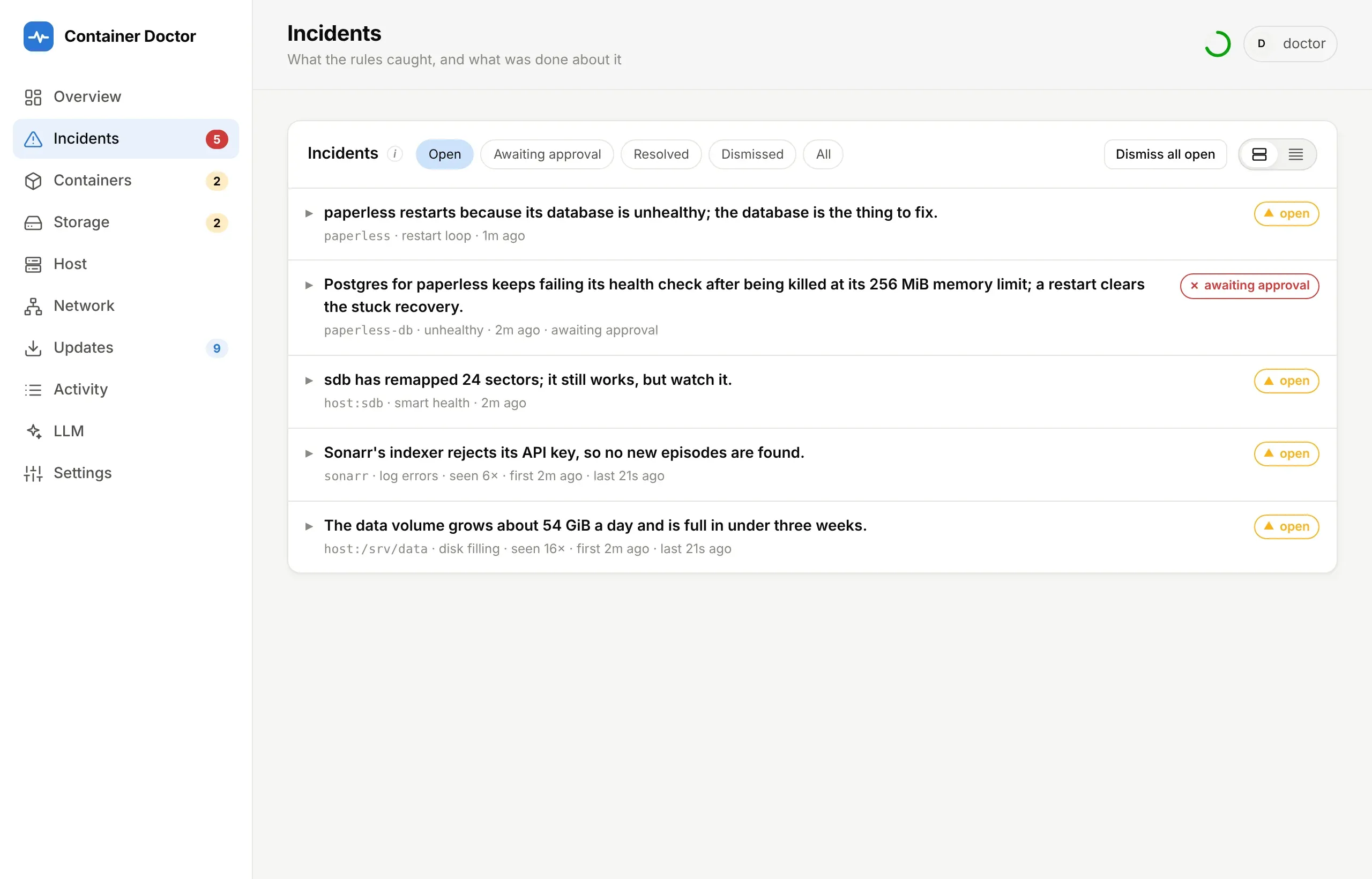
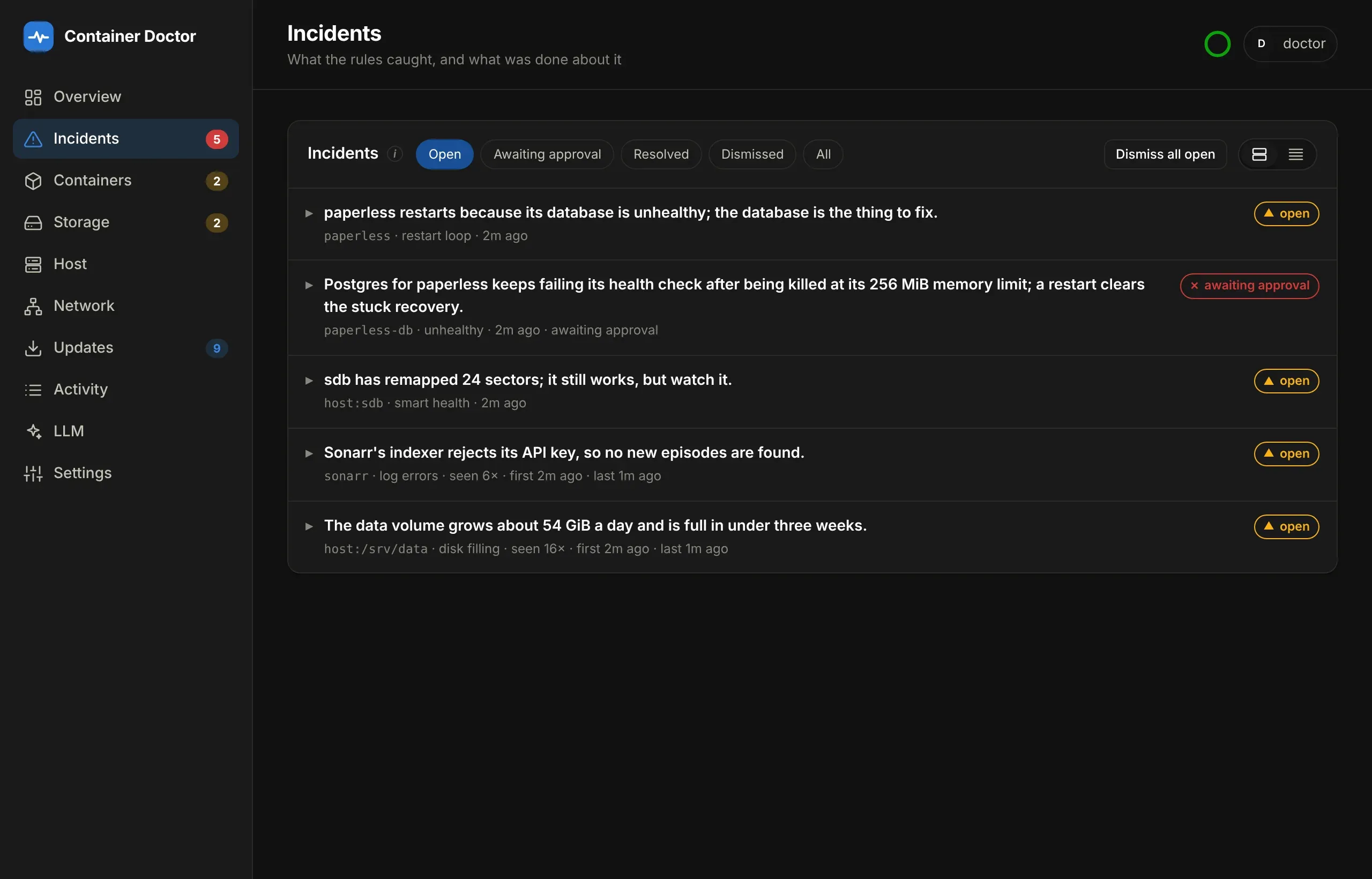
Section titled “Clearing out a run of false alarms”Dismiss all open in the incidents panel closes every open incident at once —
for after a rule that was raising them has been fixed, where clicking through a
few hundred is not an option. They are dismissed rather than deleted: the rows
stay in the record, age out at DOCTOR_RETENTION_DAYS (default 30), and a
deleted incident would take its audit trail of actions with it.