What changed
Every poll is compared against the last one, and what changed is written down:
- Recreated, by a redeploy. A recreate names the image it came up on: a new
version (
sonarr:4.0.20→4.0.21), or a new build of the same tag, which means the tag moved and a redeploy pulled it. A new name for the same build —server:2026.8.3pinned toserver:2026.8.3@sha256:…— is recorded as the same image, since Docker runs exactly what it ran before. Several services of one stack recreated together are marked as a redeploy of that stack. - Renamed, when a compose edit gives a service a new container name. Docker removes one container and creates another; a container that appears in a stack while one of the same stack is missing, with the same service name or the same image, is recorded as that service renamed rather than as a new container. Only an unambiguous match counts.
- What it runs with. A recreate or rename is also compared against the
configuration the container ran with before, read from its own
docker inspect: environment, memory and CPU limits, capabilities, mounts, ports, networks, restart policy, healthcheck, command and labels. The summary names the first few differences (“config: memory limit 1g → 512m, env TZ UTC → Europe/Zurich”) or says the configuration is unchanged. This works whatever deployed the container - no repository, Portainer token or extra socket permission is needed. Env values follow the same allowlist the rest of the doctor uses: harmless ones (TZ, PUID,*_URL, …) are shown after redaction; every other value, and any label whose name looks secret, is stored only as a keyed hash, so a change is reported as “changed (value not shown)”. The key is made once per install inenv-hash.keynext to the database. Containers last seen before this existed have nothing to compare against, and say nothing rather than “unchanged”. - Restarted, started or stopped. A restart says whether the restart policy did it or the doctor did. Restarts in a crash loop count up one row instead of adding one every few seconds.
The times are Docker’s own, from each container’s Created and StartedAt, not
the poll’s, so they line up with the logs. The last state seen is kept in SQLite:
a change made while the doctor was down is still caught when it comes back, and
restarting the doctor itself doesn’t look like thirty recreates.
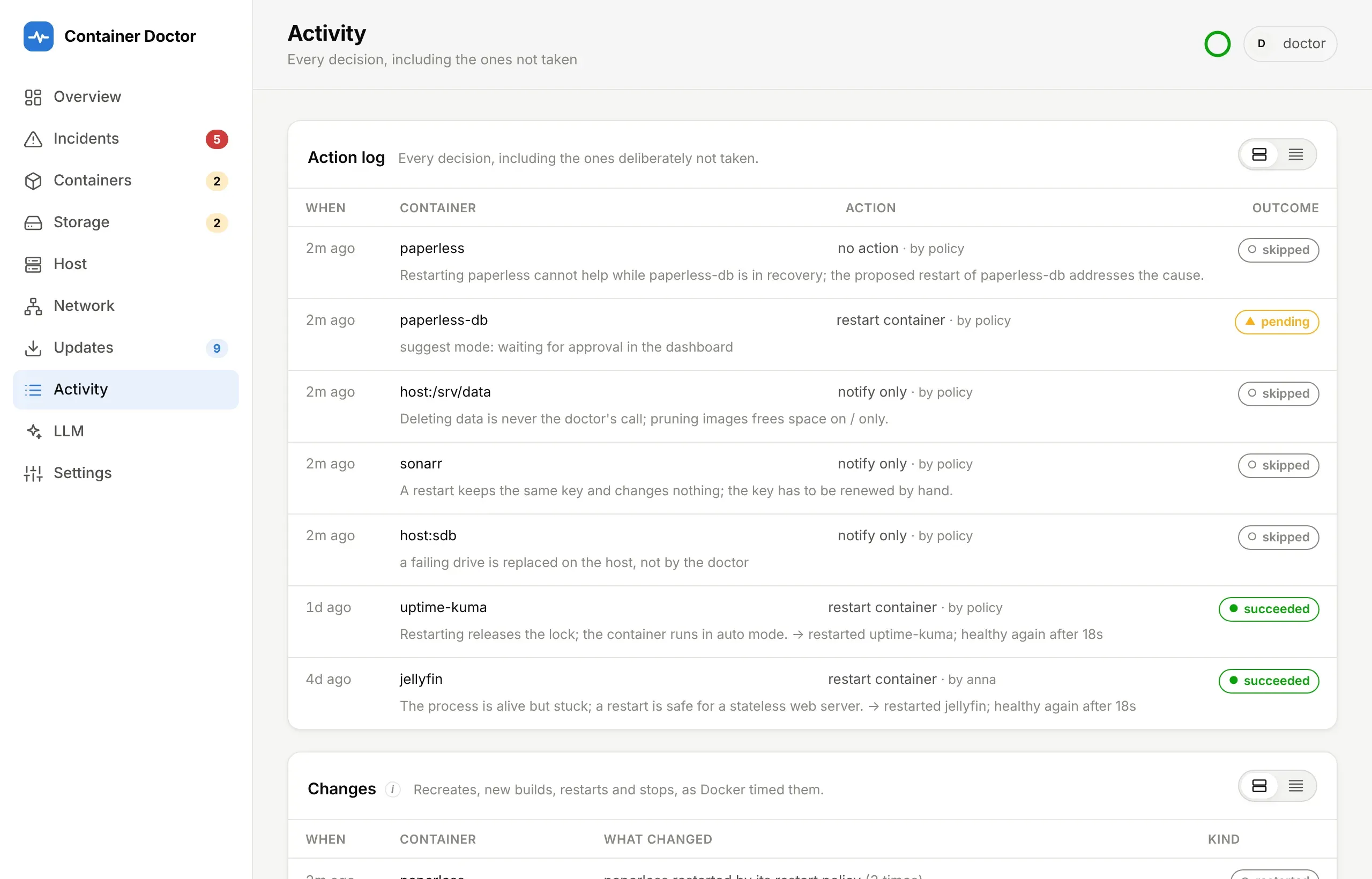
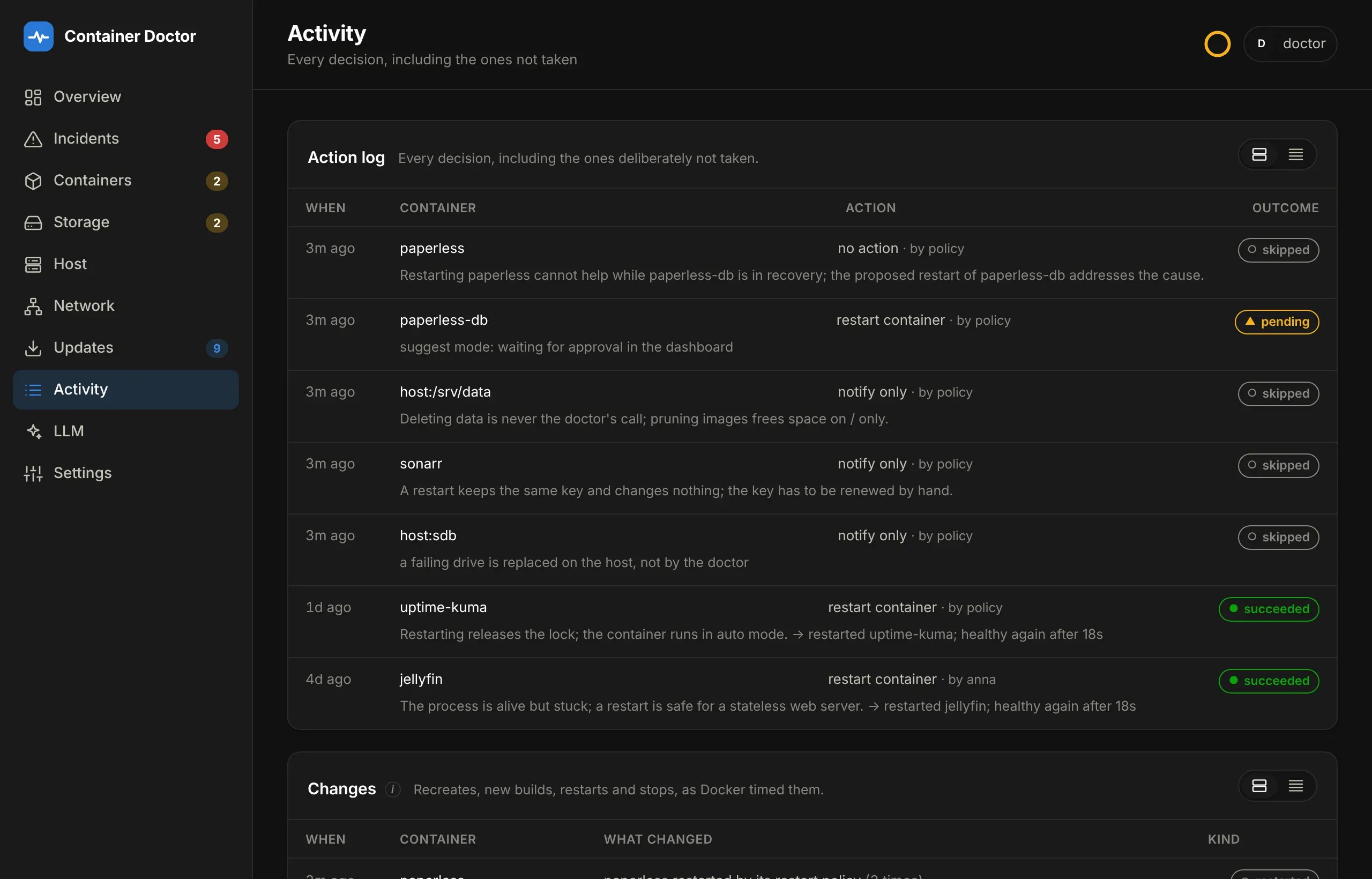
It shows as Changes under Activity and as What changed on each container’s view. It’s also given to the diagnosis: the model sees the container’s changes from the last week, each timed against the detection (“10 min before detection”). A recreate on a new build shortly before the errors started is usually most of the answer, and the prompt says so; when nothing in the timeline moved the image, it says that instead, so the model doesn’t go looking for an earlier image to roll back to. Configuration differences are listed under the change they came with; when image and configuration were both compared and neither moved, the prompt says what that leaves: the workload, its data, or something outside the container. The briefing mentions the last day’s recreates.