
Introduction
Container Doctor is an AI triage agent for the Docker containers on one Linux host. It watches the Docker event stream and container stats, opens an incident when a deterministic rule says something is genuinely wrong, asks a model to explain why, and - only if you let it - applies one narrow remediation and checks whether that actually helped. Everything it sees, thinks and does is visible in a web dashboard.
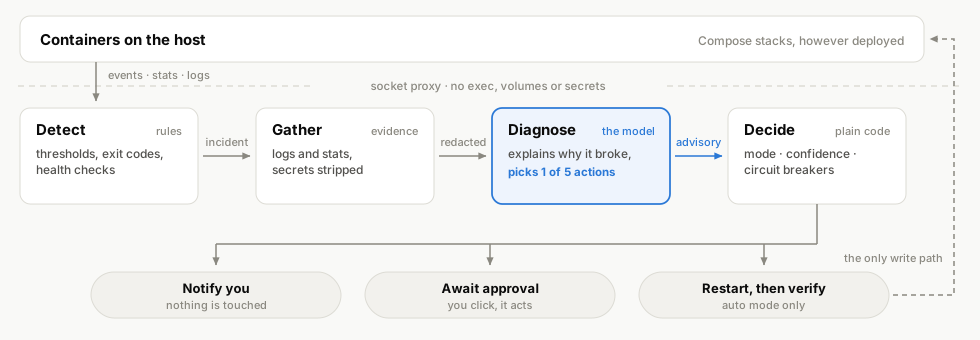
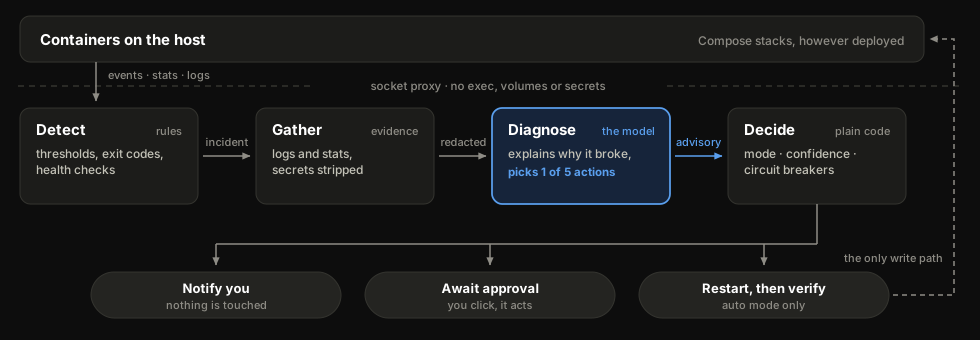
The shape of it: rules decide whether something is wrong, a model only
explains why, and plain deterministic code decides what - if anything - happens
next. The model’s output is constrained to five fixed actions. In observe
and suggest it is advisory only, so a bad diagnosis costs you a wrong
explanation, not a restart. In auto mode the doctor does trust the model’s
recommendation - but only within the allowed actions, the confidence
threshold and the rate limits, and only on the incident’s own container.
It runs as a Compose stack of its own, deployed however you deploy the rest:
it reads Docker and Compose’s own labels, whatever started the containers.
Docker itself is reached only through a socket proxy that lets the doctor
restart a container but never create one - POST /containers/create accepts
arbitrary host bind mounts, so an open create endpoint is a container escape.
What you get
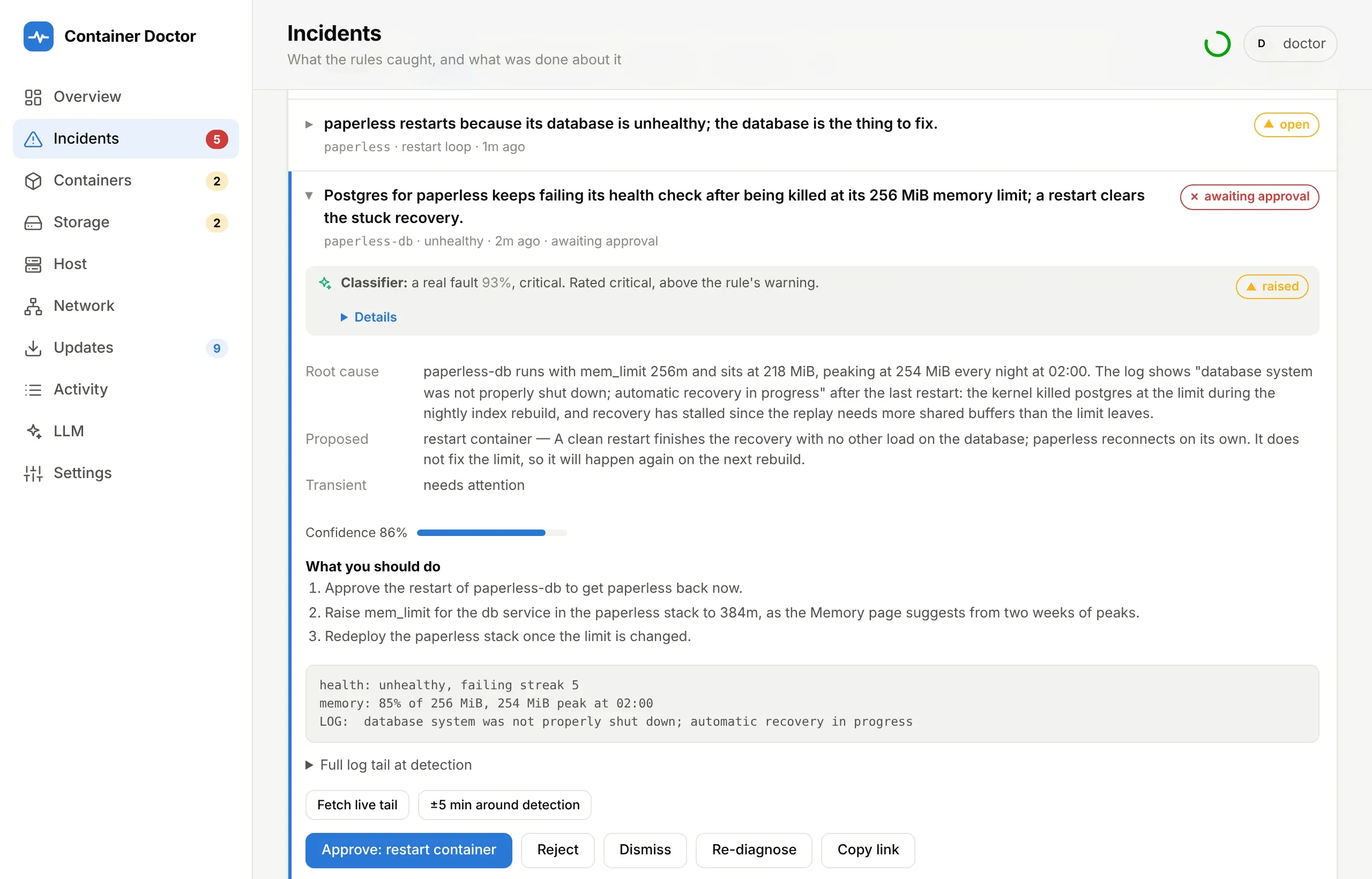
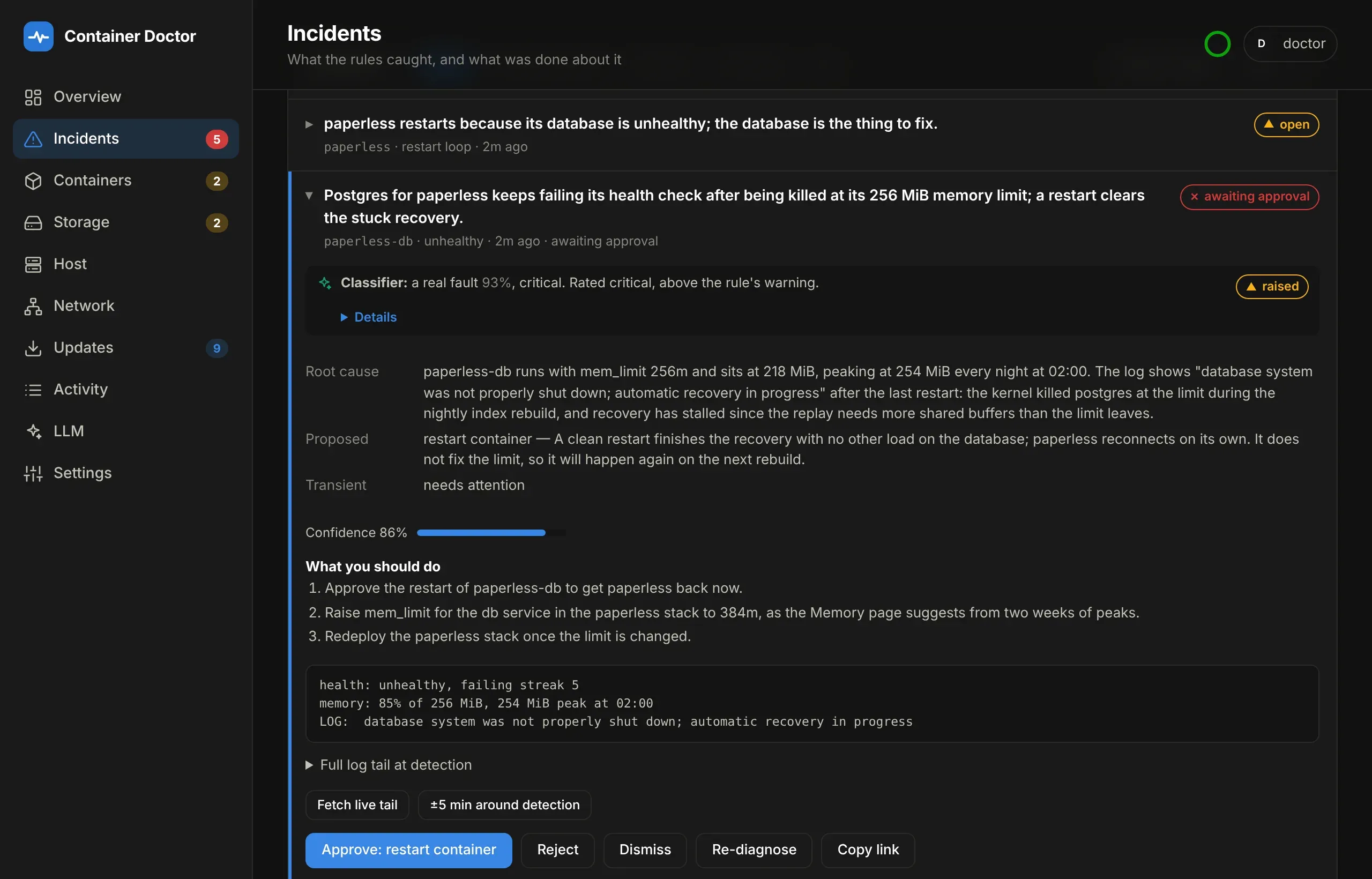
Section titled “What you get”- Incidents, not alerts. Crashes, restart loops, failing health checks, OOM kills, error bursts in the logs, full or filling disks, degraded RAID arrays, failing drives, an unreachable internet - each opened once, folded while it recurs, and closed when it clears.
- An explanation for each. A model reads the evidence - logs with secrets redacted, the container’s configuration and what changed, its stack’s neighbours, the host’s state - and says what went wrong and what would fix it.
- Actions only on your terms.
observechanges nothing,suggestasks you first,autoacts only where you allowed it, inside rate limits and cooldowns, and verifies the result. - The rest of the picture. Image updates with release notes, a network map, memory-limit suggestions, a change log per container, SMART and RAID health.
Design choices
Section titled “Design choices”The idea comes from “Docker Container Doctor”. That write-up is a good proof of concept, but a few things in it don’t survive contact with a home server that holds your photos. This implementation changes them deliberately:
| The usual pattern | What this does instead | Why |
|---|---|---|
Mount /var/run/docker.sock into the agent |
Talks to a socket proxy with a narrow endpoint allowlist, as a non-root user, with a read-only root filesystem | The raw socket is root on the host. An LLM-driven process is the last thing that should hold it |
| The LLM decides the fix and the code runs it | The LLM picks one action from a closed enum; a deterministic policy engine decides whether it may run | Prompt injection via a container log must not become “restart my database” |
| Call the model on anything that looks odd | Rules open the incident; the model only ever explains an incident that already exists | The model is the expensive, non-deterministic part. Keep it off the critical path |
| Call the model every time | Identical failures are fingerprinted and reuse a cached diagnosis; a daily USD budget stops new calls | A restart loop would otherwise bill you once per restart |
| Send the logs as-is | Secrets are redacted, best effort, before evidence is stored or sent | Plenty of apps take bearer tokens as env vars, and they end up in logs |
| Restart on failure | Circuit breakers per container and per host, a per-fingerprint cooldown, and post-action verification | “Restart it again” is how a small problem becomes an outage |
| Auto-fix from day one | Ships in observe mode. suggest and auto are opt-in |
You should read a week of its diagnoses before it gets to touch anything |