
The classifier
The rules are exact about facts and blunt about judgement. An exit code of 137
is a fact. “Five lines matching error” may be a database failing, or an app
that logs its retries at ERROR. The classifier asks a decision model about the
judgement cases only, before an incident opens.
What it looks at: error bursts, fatal lines, failed health checks, sustained CPU and memory, and restart loops. Never exits, OOM kills, disks or arrays: those open an incident whatever a model thinks.
What it asks, in one call and from a closed list of answers:
- is this a real fault, noise, a passing state, or unclear;
- how severe it is;
- the likely cause;
- whether it will clear on its own.
The evidence is the same the diagnosis would see (redacted, including the change timeline), capped at about 3,000 tokens.
What it may do:
| Mode | Effect |
|---|---|
off |
nothing (the default) |
shadow |
records every verdict and changes nothing; each incident shows what the classifier would have done |
on |
hides a signal when a calibrated model puts noise at DOCTOR_CLASSIFIER_SUPPRESS_AT (0.9) or above; may raise a severity, or lower one it is at least that sure of |
The policy engine still decides every action, and the diagnosis still runs on whatever opens. It is shown the classifier’s read as a hint it may overrule.
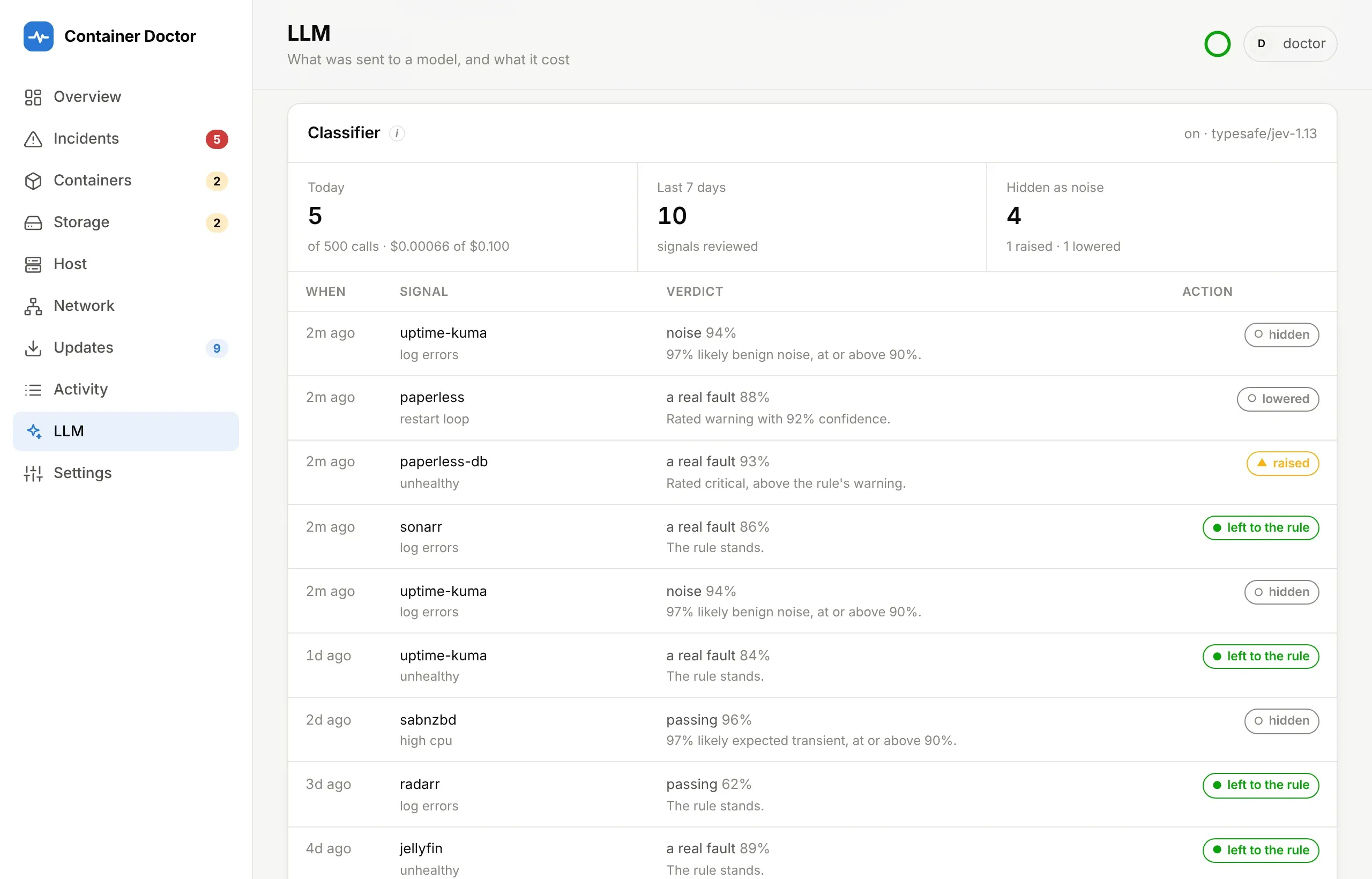
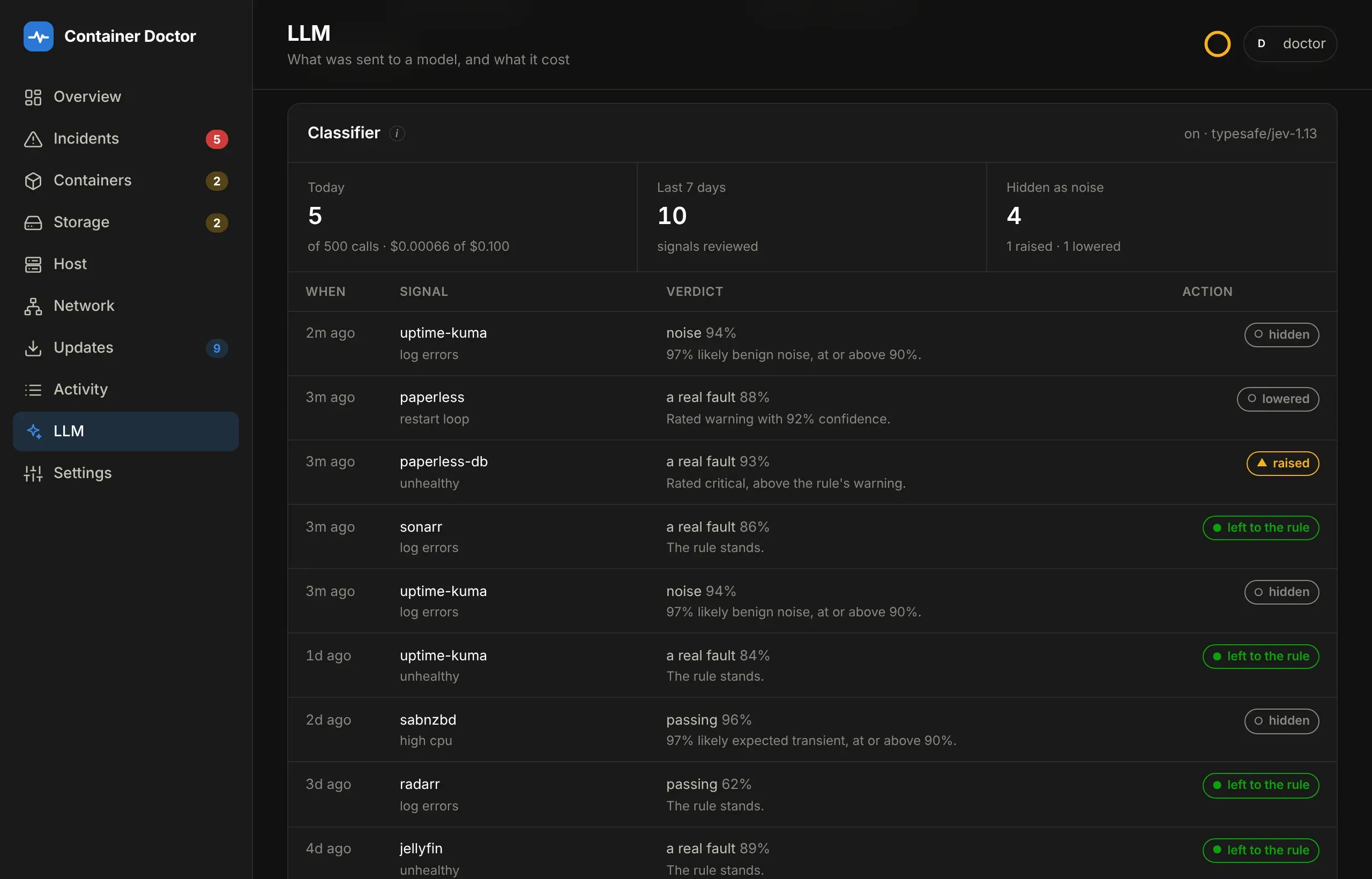
Every verdict is on the LLM page, and each incident it reviewed shows the
verdict in a line above the diagnosis, with the probabilities behind it under
Details. The live demo runs it in on.
Setting it up. The backend is a decision model on OpenRouter’s Decisions
API, TypeSafe’s Jev by default (typesafe/jev-1.13, pinned so verdicts don’t
drift):
DOCTOR_CLASSIFIER=shadowDOCTOR_CLASSIFIER_API_KEY=sk-or-...If the diagnosis already goes through OpenRouter (DOCTOR_LLM_PROVIDER=openai
with DOCTOR_OPENAI_BASE_URL=https://openrouter.ai/api/v1), the key can be
left out and the classifier uses DOCTOR_OPENAI_API_KEY. A key of its own is
still better: it can carry its own credit limit on openrouter.ai, so a runaway
classifier can’t spend the diagnosis’s money.
Run it in shadow for a week or two, and read its verdicts on the LLM page
against what actually happened before you switch to on.
DOCTOR_CLASSIFIER_PROVIDER=chat uses the diagnosis’s own chat model instead.
A chat model has no real probabilities, so it’s treated as uncalibrated: it may
annotate and raise a severity, never hide or lower one. Any other decision
model is one class in app/decision.py behind the same DecisionModel
protocol.
Cost, and the brakes on it. Jev bills input at $0.042 per million tokens,
and its output is free (as of October 2026 — check the model’s page, prices
change often; DOCTOR_CLASSIFIER_PRICE_PER_MTOK follows it). At about 3,000
tokens a call, a call costs roughly
$0.00013; 200 calls a day is under $0.03. The brakes:
- A verdict is cached against the signal for
DOCTOR_CLASSIFIER_CACHE_HOURS(6): the lines it fired on with numbers stripped, and the volume as a power of two. A burst repeating every poll is one call, and twice the volume is asked again. A signal judged noise isn’t even read again while its verdict holds. - It has its own caps, separate from the diagnosis’s:
DOCTOR_CLASSIFIER_DAILY_CALLS(500) andDOCTOR_CLASSIFIER_DAILY_USD($0.10). Its dollars still count toward the day’s total spend. DOCTOR_CLASSIFIER_MAX_PER_MINUTE(10) holds back a host coming back up with everything firing at once.- A timeout of
DOCTOR_CLASSIFIER_TIMEOUT(5 s), and a breaker: three failures in a row pause it for ten minutes. - Whenever it can’t answer, the rule decides alone. The failure mode is the doctor as it was without a classifier.
For a hard ceiling outside the doctor, give the OpenRouter key a credit limit of its own and no auto top-up.
Prompt injection. A hostile log line can only push the answer toward one of the listed options. An answer outside them is dropped. Facts are never asked about, a hidden signal is re-asked when its verdict expires or its volume doubles, and hiding needs 90%.